'Henri Tajfel's greatest contribution to psychology was social identity theory.
Social identity is a person’s sense of who they are based on their group membership(s).
Tajfel proposed that the groups (e.g. social class, family, football team etc.) which people belonged to were an important source of pride and self-esteem. Groups give us a sense of social identity: a sense of belonging to the social world.
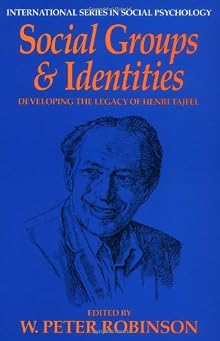
In order to increase our self-image we enhance the status of the group to which we belong. We can also increase our self-image by discriminating and being prejudice against the out group.
Therefore we divided the world into “them” and “us” based through a process of social categorisation (i.e. we put people into social groups).
This is known as in-group (us) and out-group (them). Social identity theory states that the in-group will discriminate against the out-group to enhance their self-image.
The central hypothesis of social identity theory is that group members of an in-group will seek to find negative aspects of an out-group, thus enhancing their self-image.'
Staurt Hall is a cultural theorist who devised Hall's theory of dominant (how the creator wants the audience to view the text), opposition (when the audience rejects the preferred reading and creates their own meaning of the text) and negotiated (a compromise between the dominant and opposition readings by the audience accepts parts ofthe directors views, but has their own views on parts as well) reactions to a media text.
He has written many books on cultural studies (such as Representation: cultural representations and signifying practices) and also stated that 'the media appear to reflect reality, whilst in fact they construct it'
 Dr Caroline Howarth
 is Caroline Howarth is a British lecturer in social psychology at the Institute of Social Psychology at the London School of Economics. She is noted for her social studies on the Brixton Riots and the struggle for recognition and esteem in a stigmatised community. The article examines how the struggle for recognition and esteem permeates everyday experiences in the context of young people growing up in Brixton. The first section illustrates how identity is constructed through and against the representations held by others within particular social contexts. Focusing on the varying strategies that different young people adopt in constructing a positive identity reveals the salience of racist representations in the social construction of Brixton. The second section examines the effects this can have on the self-image and self-esteem of many in the study, looking in particular at strategies used to contest negative versions of blackness. This points to the racializing and gendering within the production of local youth identities. The concluding section illustrates how some young people collaboratively develop the social and psychological resources to protect themselves against the prejudices of others. Together, this material reveals how social relationships and institutional cultures empower/disempower Brixton's youth in their collaborative struggle for recognition and esteem. This allows us to consider how new multicultures address, incorporate and resist new racisms and prejudices towards a locality.